The AI does the groundwork, you make the call
Group the schema, fill in units, draft dashboards and analyses. Four assistants that start where hours usually go. Each one proposes, you apply it with a click.
- Four assistants schema, units, dashboards, analyses
- A proposal, not an automaton applied with a click
- Vendor independent our licence or your own model
- Architecture Controller, edge client, cloud, people. Configuration comes from the cloud, the client keeps running when the line drops.
- Connectivity Seventeen protocols are built in. Discovery finds the devices, the data point editor maps them.
- Cloud-to-cloud Plants from an existing vendor cloud appear in the same tenant as native ones.
- Factory and field Provisioned and tested in series, guided in the field through to the handover record. Without specialists.
- Hardware Panel and gateway from our own production. Only approved hardware connects.
Where the time goes today
A controller delivers a thousand data points and more. None of them are wrong, but raw they are unusable: they come in the order of the register map, they carry engineering abbreviations and often no unit at all. Before that becomes a plant overview, somebody sits down and sorts.
That is exactly where the assistants start. Not at the control, not at the decision, but at the groundwork before it.
The four assistants
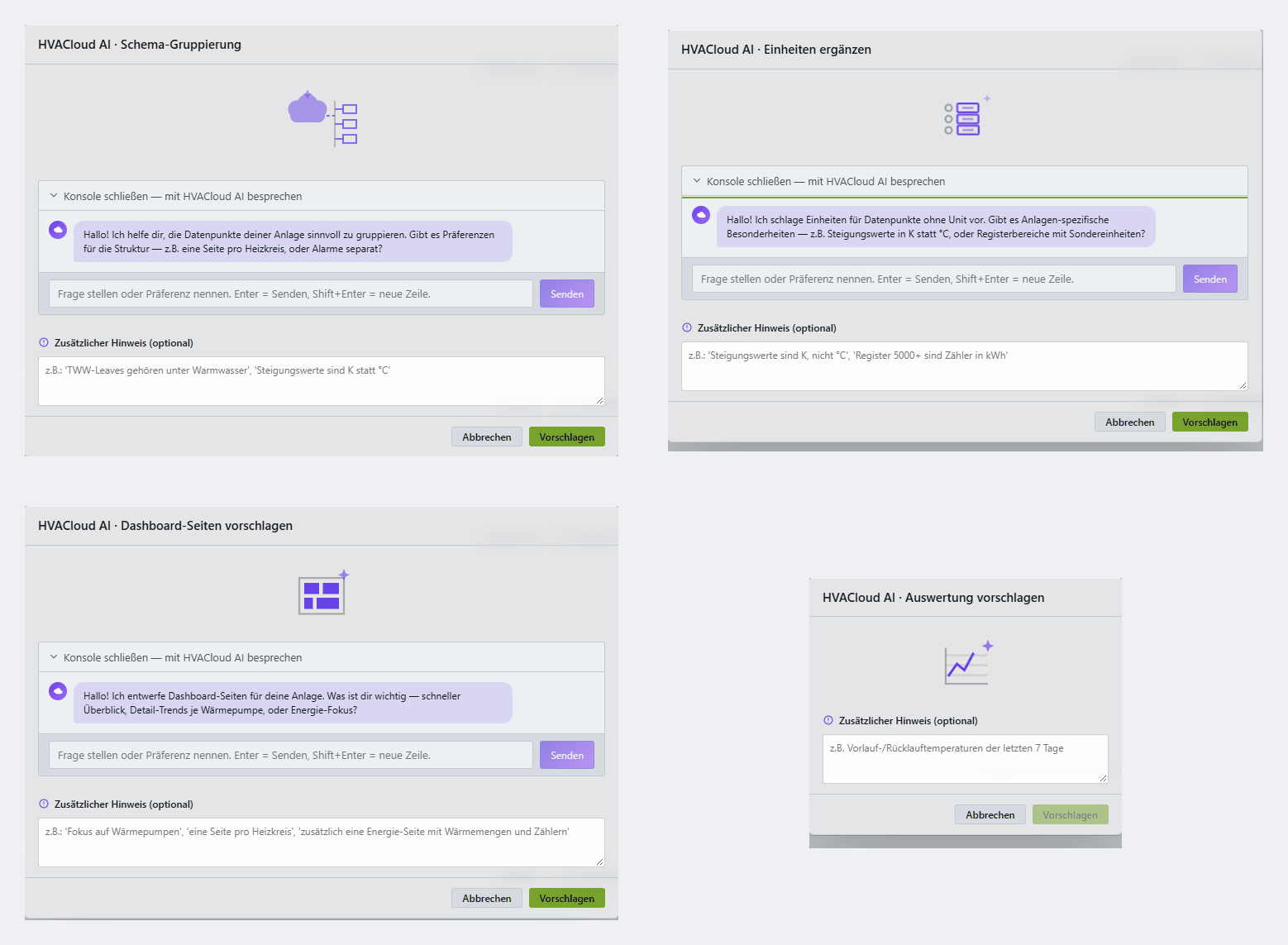
Group the schema. The flat list becomes a structure, by heating circuits, by trades, alarms separate. You can say beforehand how you want it, for instance that hot water leaves belong under hot water.
Fill in units. Data points without a unit get a proposal, with regard for the quirks of the plant. Slope values are in K and not in °C, and a register may well be a meter in kWh.
Propose dashboard pages. A page layout for the plant, aimed at what you want to see: a quick overview, detail trends per heat generator, or a page of its own for energy.
Propose analyses. A set of curves derived from the question you want answered, such as flow and return temperatures over the last seven days.
A proposal, not an automaton
Every assistant ends with a proposal and a button. Nothing is applied without a person looking at it. That is the same line as in Research and edge AI: the AI narrows things down and proposes, people decide.
Every assistant can be talked to first. One line of context, a house rule of yours for instance, goes into the proposal.
Vendor independent
We tie you to no model and to no vendor.
- Licensed through us. You use the assistants without entering a contract of your own.
- With your own account. You store your own credentials and settle directly with your provider.
- With your own model. Whoever runs a model in house connects it.
Who the third option matters to is usually clear already: anyone who has data sovereignty as a requirement wants to know where the AI computes as well. That is the same reason the platform also runs on premise. Security and scale
This is what it looks like
Four assistants, four dialogues
Each one first asks what matters to you, then proposes. Nothing is applied without somebody looking at it.
Better shown than read
We will show you this area on a real plant, set up around the equipment you build.